The July 2026 residential real estate statistics are in, and they continue to point to a Windsor-Essex market where buyers have more choice and sellers need to be increasingly strategic.
The headline numbers show fewer sales and softer prices compared with last year. However, that does not mean every property has declined by the same amount or that buyers have stopped purchasing.
Instead, buyers are being selective, affordability remains a significant barrier, and results vary considerably depending on the property type, location, price range and condition of the home.
July 2026 Residential Market at a Glance
According to the Windsor-Essex County Association of REALTORS®, July recorded:
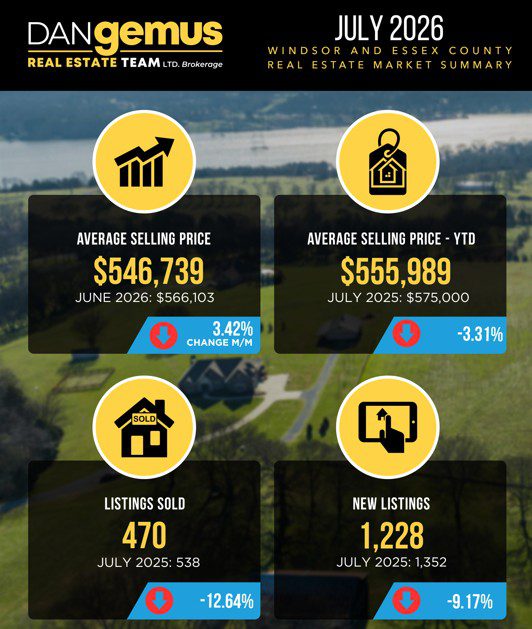
- 1,228 new residential listings, down 9.17% from July 2025
- 470 residential sales, down 12.64%
- An average residential sale price of $546,739, down 6.98%
- A median residential sale price of $509,500, down 3.87%
Year to date, the average residential sale price was $555,989, down 3.31% from the same period in 2025. Year-to-date residential sales declined by 5.26%.
The broader Windsor-Essex residential market report showed 2,307 active listings at the end of July, an increase of 3.5% from one year ago. Months of inventory rose from 3.9 months in July 2025 to 4.4 months in July 2026. The median time on market also increased from 18.5 to 20.5 days.
Together, these numbers indicate that buyers generally have more properties to consider, while sellers face more competition for the available buyers.
What Does the Decline in Average Price Really Mean?
The average residential sale price declined from $587,740 in July 2025 to $546,739 in July 2026, a decrease of approximately 7%.
However, the median price declined by a smaller 3.87%.
That difference is important.
The average price is calculated by adding all sale prices together and dividing that amount by the number of sales. A change in the number of higher-priced or lower-priced properties selling during a particular month can have a noticeable effect on the average.
The median represents the middle transaction when all sales are arranged from lowest to highest. It is less affected by a small number of unusually expensive sales.
This means the 7% decline in the average price should not be interpreted as proof that every Windsor-Essex home has lost 7% of its value.
To determine what an individual property may be worth, homeowners need to examine recent comparable sales involving similar homes in the same municipality, neighbourhood and price range.
Affordability Is Still Limiting Buyer Activity
Lower prices do not automatically make a home affordable.
Buyers must consider the complete monthly cost of ownership, including the mortgage payment, property taxes, utilities, insurance, maintenance and the rising cost of everyday expenses.
CMHC reported in its summer 2026 outlook that housing activity had been weaker than expected due to higher mortgage rates, slow income growth and continued economic uncertainty. It also noted that improving affordability alone had not been enough to bring many buyers back into the market.
The Bank of Canada has described the Canadian economy as having experienced a period of weakness, although signs of improvement are beginning to appear. It has also stated that uncertainty remains elevated.
This helps explain why a property can generate online views, open-house traffic and inquiries without immediately producing an offer.
There may be plenty of people who like a home, but a smaller number who can comfortably afford to purchase it.
What the July Market Means for Buyers
For buyers, increased inventory can create an opportunity to compare homes more carefully rather than feeling pressured to purchase the first suitable property they see.
Buyers may have more time to evaluate:
- Recent comparable sales
- The condition of the home
- Required renovations or repairs
- Property taxes and monthly carrying costs
- Competing listings
- Appropriate financing, inspection or insurance conditions
This does not mean every property will be heavily negotiable. Attractive homes that are well maintained and properly priced can still generate strong interest.
The best opportunities usually come from understanding the specific property and its competition, rather than assuming every seller must accept a substantially lower offer.
What the July Market Means for Sellers
Homes are still selling, but sellers are competing for a smaller and more cautious group of buyers.
Because residential sales declined faster than new listings in July, buyers generally had more options available to them.
For sellers, this makes three things especially important.
Pricing for Today’s Market
Buyers compare a home with both recent sales and the properties currently available.
A pricing strategy based on what a neighbour sold for during a stronger market may not reflect what buyers can or will pay today.
Pricing accurately does not mean giving a property away. It means positioning the home where buyers recognize its value and are motivated to take action.
Strong Presentation
When buyers have more choice, condition and presentation matter.
Cleanliness, repairs, decluttering, professional photography and convenient showing access can all affect how a property compares with its competition.
A buyer may overlook certain imperfections when inventory is limited. When several alternatives are available, those same concerns may become reasons to select another home.
Responding to Market Feedback
Homes are generally taking longer to sell than they did one year ago. That does not mean every property needs an immediate price reduction, but limited or no showings or repeated negative feedback should be taken seriously.
Sellers should consider whether the property is priced properly, showing well and competing effectively against similar listings.
Waiting may be appropriate. Waiting without reviewing the market response can be costly.
A Difficult Reality for Some Pandemic-Era Buyers
Some homeowners who purchased during the highly competitive market of 2021 and early 2022 may face a difficult situation when it is time to sell.
In July 2021, Windsor-Essex had only 1.1 months of residential inventory. By July 2026, that figure had increased to 4.4 months. The average sale-to-list price ratio was 126.4% in July 2021, compared with 100.1% in July 2026.
During the market peak, buyers were competing in an environment with very little inventory, lower borrowing costs and frequent multiple offers. Some paid considerably above the asking price to secure a home.
Those market conditions no longer exist to the same degree.
This does not mean every pandemic-era buyer overpaid or that every home purchased during that period is now worth less. The original purchase date, location, property type, condition and improvements all matter.
However, the amount a homeowner paid does not automatically establish what the next buyer will be willing or able to pay.
Renovations can improve a property’s appeal and value, but the market does not always return every dollar invested. Buyers compare the finished home with other properties they can purchase today. They do not calculate value based solely on the seller’s original purchase price, renovation costs or financial needs.
For homeowners considering a move, the better question is not simply:
“How much do I need to get back?”
It is:
“What is my property realistically worth in today’s market, and what options do I have based on that number?”
That analysis should include the expected sale price, mortgage balance, selling expenses and the cost of the homeowner’s next move.
Not Every Property Type Is Experiencing the Same Market
Regional averages are useful, but they do not tell the whole story.
In July, the broader MLS report showed:
- Single-family homes had 3.9 months of inventory
- Townhouses had 3.5 months of inventory
- Condos had 12.7 months of inventory
Single-family homes recorded an average sale price of $561,225, compared with $418,830 for townhouses and $386,622 for condos.
A condominium seller may therefore experience very different conditions from someone selling an entry-level bungalow. Waterfront homes, rural properties, luxury listings and homes requiring substantial renovations may each have their own buyer pool and market conditions.
This is why buying or selling decisions should not be based on the regional average alone.
The Bottom Line
The greatest challenge in the current market may not be a lack of interest in homeownership.
It may be the gap between what buyers would like to purchase, what they can comfortably afford and what some sellers need or expect to receive.
Buyers generally have more choice and may have greater negotiating power on certain properties. Sellers can still achieve strong results, but accurate pricing, professional presentation and a realistic understanding of current conditions are increasingly important.
Successful moves are still happening throughout Windsor-Essex. They simply require more careful planning, honest conversations and a strategy based on today’s market rather than the extraordinary conditions experienced during 2021 and 2022.
Every property and every situation is different. Before making a decision, buyers and sellers should consider their specific municipality, neighbourhood, property type, price range and personal financial goals.
Are you wondering what these market changes mean for your home or your next move? Contact the Dan Gemus Real Estate Team for a personalized review of your options and the current conditions in your area.
*This blog is for information purposes only and is not intended to replace legal, accounting, financial or environmental advice nor is it intended to solicit those currently under contract with another Brokerage.
Sources: Windsor-Essex County Association of REALTORS®, MLS® Statistic Report, July 2026, CREA and the Windsor-Essex County Association of REALTORS®, Residential Market Activity and MLS® Home Price Index Report, July 2026, CMHC Summer 2026 Housing Market Outlook and the Bank of Canada July 2026 Monetary Policy Report