
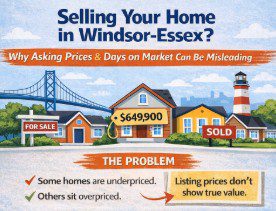
If you’re thinking about selling in Windsor-Essex, one of the first things you probably look at is asking prices.
It feels logical.
“If the house down the street is listed at $649,900, that must be what mine is worth.”
Not necessarily.
In today’s Windsor-Essex real estate market, asking prices and days on market can both mislead and empower you. The difference comes down to understanding what those numbers really represent.
As a leading real estate team serving Windsor and Essex County, at The Dan Gemus Real Estate Team Ltd, Brokerage, we believe in educating our clients so they can make clear, informed and strategic decisions based on their unique circumstances.
Let’s break it down clearly.
Asking Price Is a Strategy. Sale Price Is Reality.
An asking price is a marketing decision.
A sale price is a data point.
That distinction matters.
It’s fact vs. fiction. An asking price on a home is fiction until it sells, then that final selling price becomes a fact.
In a balanced or buyer-leaning market like we’ve seen across much of Windsor-Essex recently, sellers are using very different pricing strategies depending on neighbourhood, price point, and property type.
Here’s where asking prices can mislead:
1. Intentional Underpricing
Some homes are priced below market value to:
-
Generate urgency
-
Attract multiple buyers
-
Create perceived competition
-
Encourage bidding
If you anchor your value to that list price, you may underprice your own home without realizing it.
This strategy still shows up in entry-level Windsor properties where affordability drives demand.
2. Aspirational Overpricing
Other sellers list high to “leave room to negotiate.”
The problem?
Buyers today are more cautious. If a home sits overpriced, it can:
-
Accumulate days on market
-
Signal “something is wrong”
-
Ultimately sell below fair value after price reductions
If you base your value on an overpriced listing that hasn’t sold, you may be anchoring to fiction.
3. Different Micro-Markets Within Windsor-Essex
A condo in South Windsor behaves differently than a waterfront home in Tecumseh.
A country property in Essex County moves differently than a mid-range LaSalle family home.
Using asking prices across different niches is like comparing apples and oranges.
What matters more is:
-
Recent sold comparables
-
Price per square foot
-
Condition adjustments
-
Inventory levels in your specific price bracket
When Asking Prices Can Help You
Asking prices aren’t useless. They just need context.
They help when:
✔ You’re Watching Active Competition
If three homes similar to yours are currently listed at $699,900 and none have sold, that tells you buyers may be resisting that number.
Active listings tell you what your competition is asking buyers to consider today.
✔ You’re Testing Demand Psychology
In certain ranges, for example under $500,000, pricing just under a threshold can dramatically increase showings.
$499,900 attracts a different search filter than $505,000.
That’s where strategic asking price matters.
Days on Market: Another Number That Needs Context
Days on market (DOM) can also mislead sellers.
At first glance, DOM seems simple:
Low days = hot property
High days = problem listing
But in Windsor-Essex, DOM tells a more nuanced story.
When Days on Market Mislead
-
Relisted properties reset DOM
Some listings are cancelled and re-listed, which can artificially reduce visible days on market. You need to know the full scope so you can make an informed decision. -
Overpricing inflates DOM
The home may be perfectly fine, just incorrectly positioned. -
Market segment matters
Luxury and rural properties naturally take longer. That is normal.
Comparing DOM across different price points doesn’t give you accurate guidance.
When Days on Market Work in Your Favour
As a seller, DOM can be powerful.
If average days on market in your bracket is 28 and you’re receiving strong traffic in week one, that’s leverage.
If competing homes have been sitting for 45 days and yours is newly listed, buyers may perceive yours as “fresh” and move quicker.
DOM helps you measure:
-
Market absorption
-
Buyer urgency
-
Negotiation strength
But it only works when compared properly within your segment.
What Stats Should You Actually Understand as a Seller?
If you’re preparing to list in Windsor-Essex, these are the numbers that matter most:
1. Sold Prices (Not Just Asking Prices)
-
What did similar homes actually sell for?
-
What was the list-to-sale ratio?
-
How many price reductions occurred before sale?
Sale data shows buyer behaviour.
List prices show seller hope.
2. Months of Inventory
This tells you whether your specific segment is:
-
Seller-favoured
-
Balanced
-
Buyer-favoured
Two months of inventory feels very different than six.
3. List-to-Sale Ratio
If homes are selling at:
-
99–100% of asking → pricing is tight
-
95% of asking → negotiation room exists
-
102% of asking → underpricing strategy at play
This number reveals pricing strategy in your neighbourhood.
4. Average Days on Market (In Your Price Band)
Don’t look at overall Windsor-Essex averages.
Look at:
-
Your neighbourhood
-
Your property type
-
Your price range
That’s where meaningful insight lives.
5. Price Adjustments Before Sale
If most homes required one or two price drops before selling, that signals initial overpricing.
That’s valuable for avoiding the same mistake.
The Risk of Chasing the Market
Here’s what we see far too often.
A seller prices high because “others are listed there.”
Showings slow.
Price drops follow.
Buyers gain leverage.
The home sells below what it likely could have achieved with strategic positioning from day one.
In Windsor-Essex, pricing correctly at launch is often the difference between:
-
Strong early interest and negotiating power
-
Or extended exposure and reactive reductions
The Advantage of Informed Pricing
When you understand:
-
Why a neighbour listed low
-
Why another neighbour sat high
-
What similar homes actually closed for
-
How long buyers in your bracket take to decide
You gain control.
Asking prices stop being emotional anchors and start becoming pro-active and strategic tools.
Days on market stops feeling scary and starts becoming measurable feedback.
That’s the shift.
Final Thought for Windsor-Essex Sellers
The Windsor-Essex real estate market is not one single story. Every town, neighbourhood, street, and niche market in Windsor-Essex perform and much different levels. Relying on regional stats can be very misleading and potentially cost you when it comes time to buying and selling in Windsor-Essex.
Entry-level homes, downsizers, rural properties, waterfront, luxury, and condos are all behaving differently right now.
The goal is not to “beat the asking price down the street.”
The goal is to position your home based on:
-
Real sold data
-
Current competition
-
Buyer psychology
-
Inventory levels
-
Timing
When sellers understand the right stats, decisions become clearer and less stressful.
At The Dan Gemus Real Estate Team, we believe informed sellers make stronger decisions. Understanding the data behind the market, not just the headlines or the sign down the street, allows homeowners across Windsor and Essex County to move confidently. Whether you’re months away from selling or actively preparing, having clarity around pricing strategy and market behaviour makes all the difference. If you are thinking of making a move in Windsor-Essex, you can reach out to the experienced professionals at The Dan Gemus Real Estate Team Ltd., Brokerage, 7 days/week.
This blog is for informational purposes only. It is not intended to solicit those under currently under contract with another Brokerage, nor is it intended to replace legal, accounting, financial or environmental advice.