The August 2026 Windsor-Essex real estate numbers are in, and the story behind the numbers is more important than any single statistic.
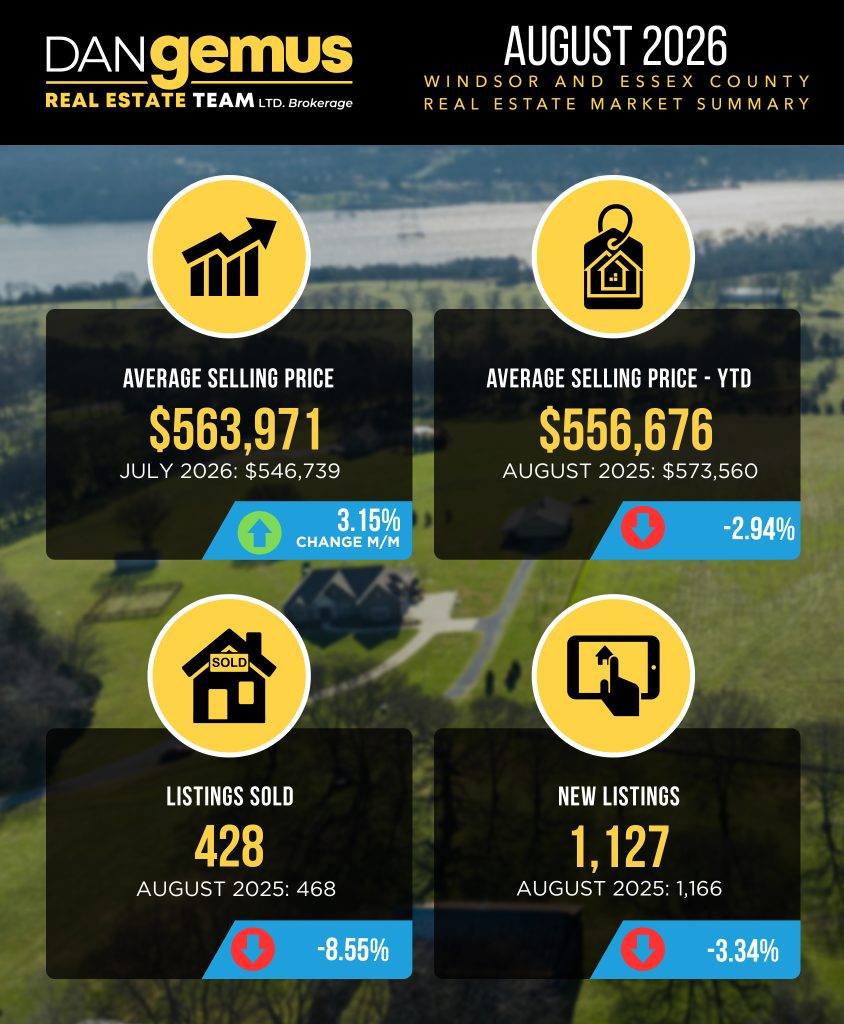
According to the Windsor-Essex County Association of REALTORS®, the average residential sale price in August was $563,971. That represents an increase of $17,232, or approximately 3.15%, from July’s average of $546,739.
Compared with August 2025, however, prices were essentially unchanged. Last August’s average was $564,428, making this year’s average only 0.08% lower.
That is an important distinction.
The month-over-month increase does not necessarily mean home values across Windsor-Essex suddenly increased by 3.15%. Average sale price can change depending on the mix of homes that sell during a particular month. What it does tell us is that, despite slower sales activity and considerably more inventory than we experienced during the pandemic-era market, prices have remained relatively resilient.
August 2026 Windsor-Essex Market at a Glance
WECAR reported the following residential activity for August:
- Average sale price: $563,971
- Median sale price: $515,000
- Residential sales: 428
- Residential listings: 1,127
- Average price vs. August 2025: down just 0.08%
- Residential sales vs. August 2025: down 8.55%
- Residential listings vs. August 2025: down 3.34%
Year to date, the average residential sale price sits at $556,676, compared with $573,560 during the same period last year.
But these numbers only tell part of the story.
Why This Could Be an Interesting Market for Buyers
For buyers who are financially prepared to purchase, today’s market offers something that was very difficult to find several years ago:
choice.
The CREA market activity report recorded 2,255 active listings at the end of August and approximately 4.8 months of inventory across the broader residential market. For comparison, Windsor-Essex had only 1.1 months of inventory in August 2021.
That difference dramatically changes the buying experience.
A market with more inventory can give buyers an opportunity to compare properties, assess value more carefully and potentially negotiate terms rather than simply competing to secure whatever becomes available.
The sales-to-new-listings ratio was 37.9% in August, compared with 70.1% in August 2021, another indication that buyers currently have substantially more selection relative to the number of homes being purchased.
Homes are taking a little longer to sell as well and for a buyer, that can create opportunity.
It doesn’t mean every seller will negotiate, every home is overpriced or every property will sit on the market. It means buyers generally have more ability to make thoughtful decisions than they did when inventory was extremely limited.
There is another reason buyers may want to pay attention.
While buyers have more negotiating power, the data does not currently show a dramatic collapse in home prices. The August WECAR average was virtually unchanged from a year ago, while CREA’s MLS® Home Price Index composite benchmark reached $584,300, up 0.9% from the previous month and 1.8% from one year earlier.
For buyers waiting for significantly lower prices before making a move, the better question may be:
Could today’s increased selection and negotiating environment matter more than trying to predict the lowest possible price?
The answer will depend on the buyer, property type, neighbourhood, financing and long-term plans.
There Isn’t Just One Windsor-Essex Market
One of the biggest mistakes buyers and sellers can make is treating Windsor-Essex as one single market.
August’s numbers show how dramatically conditions can differ depending on the property type.
Single-Family Homes
Single-family homes recorded approximately 4.3 months of inventory in August, with a median of 19 days on market.
That is a much more competitive environment than some other housing categories.
A well-presented detached home in a desirable neighbourhood, particularly when priced appropriately, can still generate significant buyer interest.
Townhouses
Townhouses recorded 6.3 months of inventory, up from 4.9 months in August 2025. Only 10 townhouse sales were recorded during the month compared with 43 new listings.
That creates a different competitive environment, with buyers having considerably more selection.
Apartments
The apartment segment stands out even more.
There were 12.7 months of apartment inventory in August, compared with 9.2 months one year earlier, and the median days on market reached 40 days.
That does not mean every condo or apartment is difficult to sell. Location, condo fees, building quality, amenities, condition and pricing all matter. But statistically, buyers shopping this category currently have considerably more choice.
This is why broad statements like “it’s a buyer’s market” or “prices are going up” can be misleading.
Your actual market may behave very differently.
Sellers Have a New Kind of Competition
This brings us to what may be the most important lesson in the August numbers for sellers.
For years, sellers became accustomed to asking:
“What did the house down the street sell for?”
Comparable sales are still extremely important. They help establish what buyers have recently been willing to pay for similar properties.
But in today’s market, they are only part of the pricing conversation.
A seller also needs to ask:
“What can a buyer purchase instead of my home today?”
That is your active competition.
If your home is listed at $599,900 and a buyer has eight similar homes to choose from between $575,000 and $625,000, those properties matter enormously.
Buyers will compare:
- location
- condition
- renovations
- layout
- lot and garage
- property taxes
- included features
- days on market
- presentation
- asking price
- perceived value
The buyer doesn’t have to choose your property simply because a comparable home sold for a particular amount three months ago.
They can choose the best value available today.
Pricing and Positioning Are Not the Same Thing
This is why our conversations with sellers increasingly need to go beyond simply establishing a market value.
There are really two questions.
What is the property worth based on market evidence?
And:
Where should we position it relative to the homes buyers are considering right now?
Those aren’t always exactly the same thing.
Imagine three comparable homes currently for sale.
One is completely renovated and priced at $599,900.
One needs updating and is listed at $589,900.
The third is yours.
Even if historical sales suggest a value around $600,000, listing at $619,900 because a similar property sold for that amount several months ago may place your home at a disadvantage if today’s buyer has better alternatives.
That is why active listings, expired listings, cancelled listings, recent reductions, days on market and recent sales all matter when developing a pricing strategy.
The objective isn’t simply to put a price on the house.
The objective is to position the home where buyers see compelling value.
Buyers Have Competition Too
More inventory does not mean buyers should assume they can wait indefinitely or make aggressive offers on every property.
August’s single-family numbers are an excellent example.
With approximately 4.3 months of inventory, that segment remains considerably tighter than the townhouse or apartment markets.
A property that is:
well located, well maintained, properly marketed and priced correctly can still attract multiple interested buyers.
So buyers need to understand where they actually have leverage and where they don’t.
The right strategy on a condo that has been sitting for 75 days may be completely different from the strategy required for a detached home that came on the market yesterday and is one of the best properties available in its price range.
What August Really Tells Us
The Windsor-Essex real estate market continues to normalize.
We aren’t experiencing the extremely limited inventory and intense competition of 2020 and 2021. But we also aren’t seeing evidence that all property values are simply falling.
Instead, we have a much more selective market.
Buyers have choices.
Good properties can still attract competition.
Different housing categories are behaving very differently.
And sellers need to compete for today’s buyer rather than relying entirely on yesterday’s sale.
For buyers, that can create an excellent window to explore opportunities without the same level of pressure we experienced several years ago.
For sellers, preparation, pricing, presentation and positioning have become increasingly important.
And for both, understanding the micro-market around the individual property matters far more than simply looking at the Windsor-Essex average.
Thinking About Buying or Selling?
Whether you are considering Windsor, Amherstburg, LaSalle, Tecumseh, Lakeshore, Essex, Kingsville, Leamington or Belle River, the numbers can vary substantially by neighbourhood, property type and price range.
The Dan Gemus Real Estate Team can look beyond the broad market averages and help you understand the inventory, recent sales and current competition that actually affect your property or purchase. Find out what your home is worth.
Supporting Homeownership Across Windsor-Essex.
Market statistics are based on August 2026 information published by the Windsor-Essex County Association of REALTORS® and the Canadian Real Estate Association. Real estate markets vary by location, property type and price range. Statistics are historical and should not be interpreted as a prediction of future market performance.